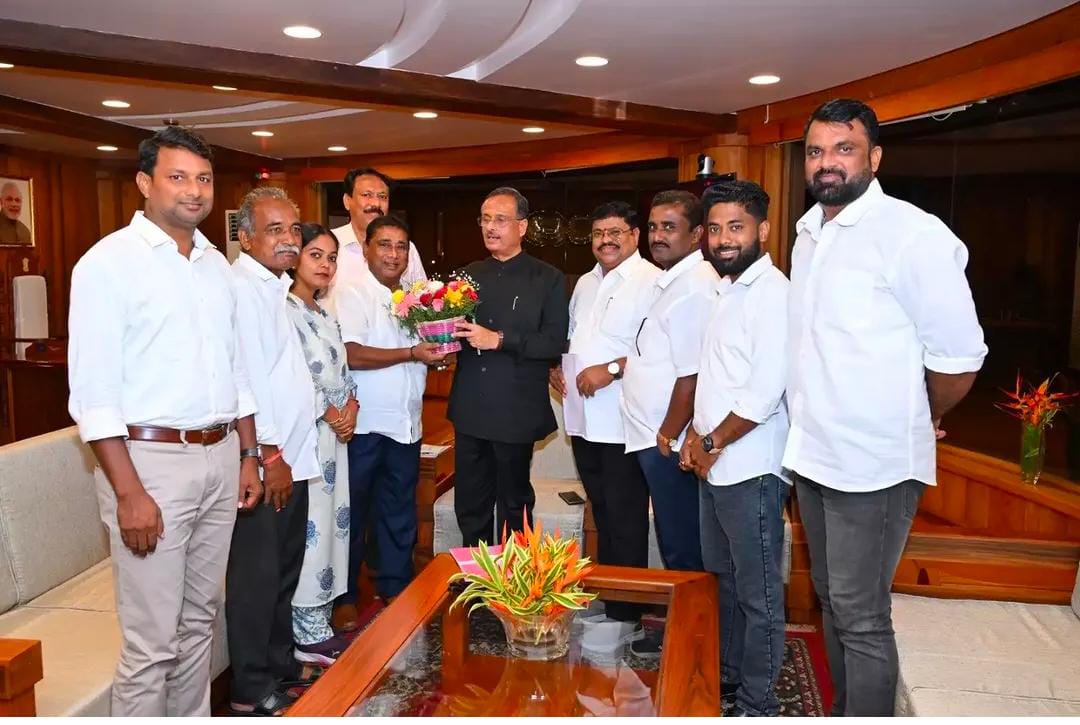
Sri Vijaya Puram, September 30: Chairman of the Andaman and Nicobar Territorial Congress Committee (ANTCC) Campaign Committee G. Bhaskar has submitted a detailed representation to the Hon’ble Lieutenant Governor of the Andaman and Nicobar Islands, placing before him a series of concerns relating to healthcare infrastructure, administration, medical manpower, equipment procurement and patient services in the Islands.
The representation follows the Lieutenant Governor’s recent visit to G.B. Pant Hospital, which functions as the teaching hospital attached to the Andaman & Nicobar Islands Institute of Medical Sciences (ANIIMS). Official ANIIMS information describes GB Pant Hospital as the attached teaching hospital and a tertiary-care centre serving patients from across the Islands. (ANIIMS)
Bhaskar thanked the Lieutenant Governor for visiting the hospital and said several issues required immediate attention to strengthen healthcare delivery.
One of the major suggestions in the representation is a clearer functional separation between ANIIMS and the Directorate of Health Services (DHS).
Bhaskar suggested making the Garacharma District Hospital fully functional and shifting DHS operations there. According to the representation, routine treatment could be handled at the district hospital, while specialised services such as neurology, nephrology and orthopaedics could be concentrated at G.B. Pant Hospital under ANIIMS.
The representation argues that such a distribution could help reduce the concentration of patients at one facility and enable ANIIMS to focus more effectively on its medical education and tertiary-care responsibilities.
The representation also calls for a dedicated surgical block with trauma-care and ICU facilities.
Bhaskar stated that the existing operating-theatre infrastructure is inadequate for the number and range of surgical departments using it. He claimed that the available theatres are shared among departments including ophthalmology, ENT, orthopaedics and general surgery, resulting in delays for patients awaiting procedures.
The representation further alleged that repeated back-to-back surgeries and infrastructure constraints have contributed to infection-related concerns, particularly in some gynaecological cases. These claims were made in the representation and have not been independently established.
It has been proposed that a new surgical block with at least 10 operation theatres be developed, along with permanent paramedical staff, nursing personnel and operation-theatre technicians.
The Congress leader has also raised concerns over the reliance on contractual appointments for doctors, paramedics and technical personnel.
The representation argues that permanent appointments could provide greater continuity and reduce uncertainty associated with contract renewals. It also claims that comparatively low remuneration and contractual conditions may make it difficult to attract and retain specialist doctors and technical staff in the Islands.
Another major issue raised concerns the procurement of medicines, surgical equipment and medical implants through the Government e-Marketplace (GeM).
Bhaskar has alleged that procurement practices based primarily on the lowest-price criteria can result in the supply of substandard medical materials. The representation specifically raises concerns about surgical equipment and orthopaedic implants and argues for a procurement mechanism that gives greater weight to quality and technical standards.
The representation has urged the Administration to examine alternatives that would enable procurement from reputed and technically qualified medical suppliers.
Bhaskar has further drawn attention to what he described as long-pending payments to local medicine and medical-supply suppliers.
According to the representation, delayed payments have affected the ability of some suppliers to continue providing medicines and essential medical materials to government hospitals.
The representation therefore seeks early clearance of pending legitimate dues to local suppliers to ensure uninterrupted availability of essential medical supplies.
The representation also proposes the establishment of an AIIMS-like medical institution in the Andaman and Nicobar Islands.
Bhaskar argued that a higher-level medical institution with advanced specialties could reduce the dependence of island patients on mainland hospitals and strengthen specialist healthcare within the Union Territory.
He also linked the proposal to the Islands' developing strategic and defence-related importance.
Several concerns relating to patients referred to the mainland under the Ayushman Bharat framework have also been highlighted.
The representation states that the existing financial coverage may not always be sufficient for patients requiring prolonged and expensive treatment, particularly in cases such as cancer, and seeks enhanced assistance for specified diseases.
It also raises the issue of travel expenses for patients and attendants travelling to the mainland. According to the representation, patients may have to initially arrange air travel expenses themselves, while reimbursement procedures can take considerable time.
The representation further highlights the financial burden associated with transporting stretcher patients by air, claiming that such arrangements can cost approximately ₹4–5 lakh when medical personnel and oxygen support are required. It seeks a mechanism under which eligible patients do not have to arrange the entire amount upfront.
The availability of advanced diagnostic and cancer-treatment facilities at G.B. Pant Hospital has also been raised as a major concern.
Bhaskar has sought the provision of MRI, PET-CT and radiation-treatment facilities, stating that their non-availability or limited availability places additional financial and logistical burdens on patients requiring such services.
At the same time, official ANIIMS material indicates that the institution has been expanding its diagnostic and specialist-care infrastructure, including a recently reported 128-slice CT facility at GB Pant Hospital.
The representation concludes by seeking the Lieutenant Governor’s intervention to examine the issues and take appropriate measures to strengthen healthcare infrastructure and services across the Islands.
The demands cover institutional coordination, surgical infrastructure, permanent manpower, procurement systems, and supplier payments, advanced medical facilities and support for patients referred to the mainland.
The representation places these matters before the Administration for consideration, with the stated objective of improving access to quality healthcare for residents of the Andaman and Nicobar Islands.